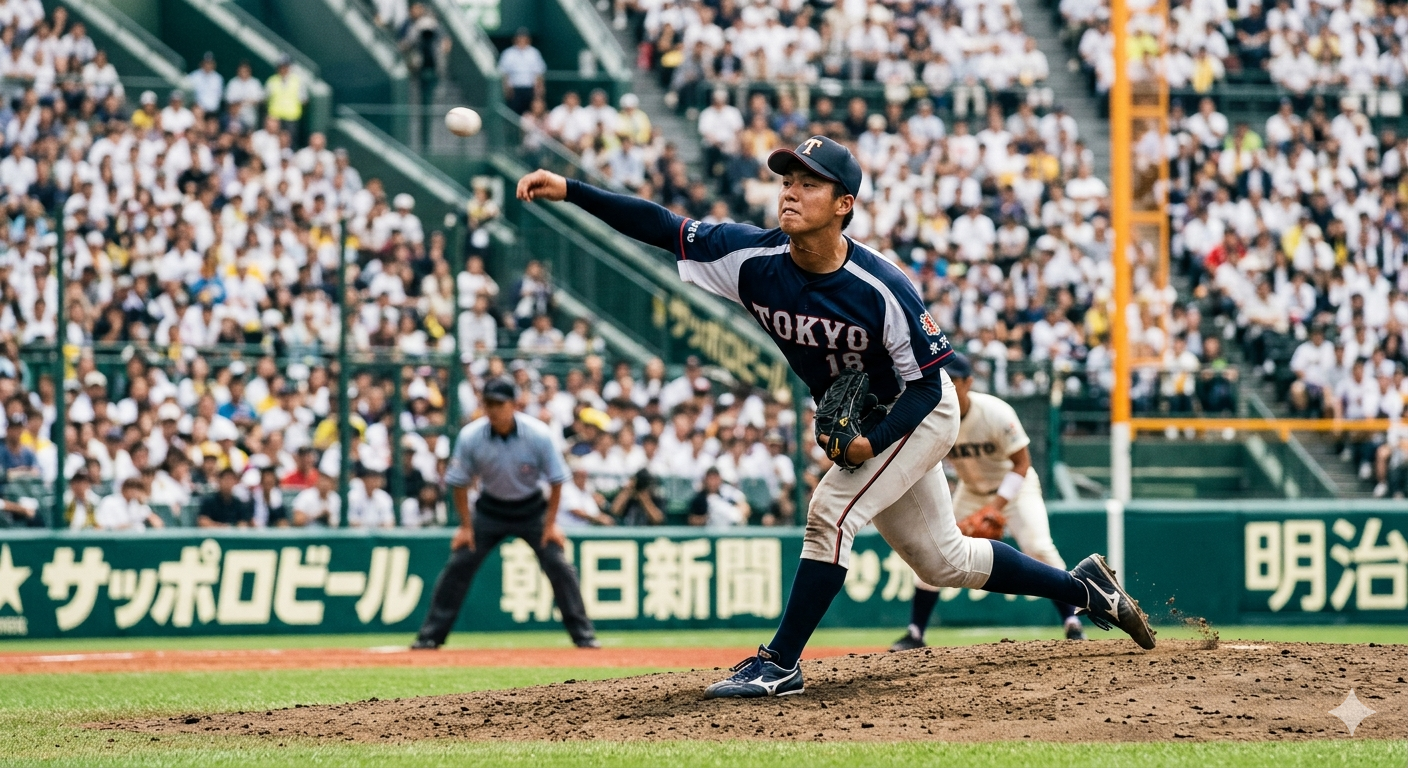
In today’s baseball culture, velocity has become king.
Radar gun numbers dominate recruiting conversations, showcases, and player development programs across the United States. But in Japan, many elite pitching instructors focus on something deeper than pure speed:
Fastball Quality
That’s why some pitchers can dominate hitters without overwhelming velocity. Their fastball seems to “jump,” stay on plane longer, or produce late swings even at average speeds.
Japanese pitching development places heavy emphasis on spin efficiency, body sequencing, rhythm, and repeatable movement patterns. The goal isn’t simply to throw harder — it’s to create a fastball that hitters struggle to square up consistently.
And honestly, this is an area where many American youth programs still have room to improve.
Many young pitchers in the U.S. are taught to throw hard before they learn how to move efficiently. That often creates arm-dominant mechanics early, which can limit long-term development.
Key Takeaways for Coaches
1. Velocity Alone Doesn’t Make a Fastball Elite
Japanese coaches often teach that an effective fastball comes from a combination of:
- Spin efficiency
- Spin direction
- Carry through the strike zone
- Command
- Late life
A pitcher throwing 80 mph with efficient backspin can often be more difficult to hit than an 85 mph pitcher with poor spin characteristics.
Hitters frequently describe these fastballs as:
- “Heavy”
- “Faster than the radar gun says”
The ball isn’t literally rising. Instead, efficient backspin helps the pitch resist gravity slightly longer, creating the illusion of “ride” through the zone.
2.Teach Young Pitchers to Stay Behind the Ball
One key concept in Japanese pitching instruction is maintaining clean backspin.
When pitchers stay behind the baseball properly, they create more true carry and cleaner flight.
But when the hand gets around the ball too early:
- The pitch cuts unintentionally
- Arm-side run becomes inconsistent
- Velocity leaks
- Command suffers
Instead of constantly yelling “throw harder,” try this:
3. Coaches Value “Tempo Before Explosion”
A major teaching point in Japanese baseball is what many coaches describe as “tame” — controlled loading and delayed acceleration.
In American baseball language, this is closely related to:
- Staying back
- Creating separation
- Delayed energy transfer
- Building momentum before release
Japanese coaches often emphasize smooth rhythm before aggressive acceleration.
This helps pitchers create whip-like arm speed instead of forcing velocity with the upper body.
Drill: Walk-In Momentum Throws
This is a simple but highly effective drill for pitchers.
How to Do It
- Start 2–3 steps behind the mound
- Walk slowly into the throw
- Build momentum toward home plate
- Let the hips lead the movement
- Allow the arm to work naturally behind rotation
To better understand the mechanics we’ve discussed.
Uehara never relied purely on overpowering velocity. Instead, he dominated hitters through:
- Fastball carry
- Command
- Spin efficiency
- Timing disruption
- Repeatable mechanics
Even major league hitters consistently described his fastball as “quicker than expected.”
If you want to see how efficient movement and pitch quality can outperform raw velocity, this is a great breakdown to study:
For youth coaches, Uehara is a powerful reminder that developing clean mechanics, rhythm, and deception can be just as important as chasing radar gun numbers.
If the video is in Japanese, you can turn on the English subtitles by clicking the ‘CC’ button and selecting ‘Auto-translate’ to ‘English’ in the YouTube settings.
Leave a Reply